
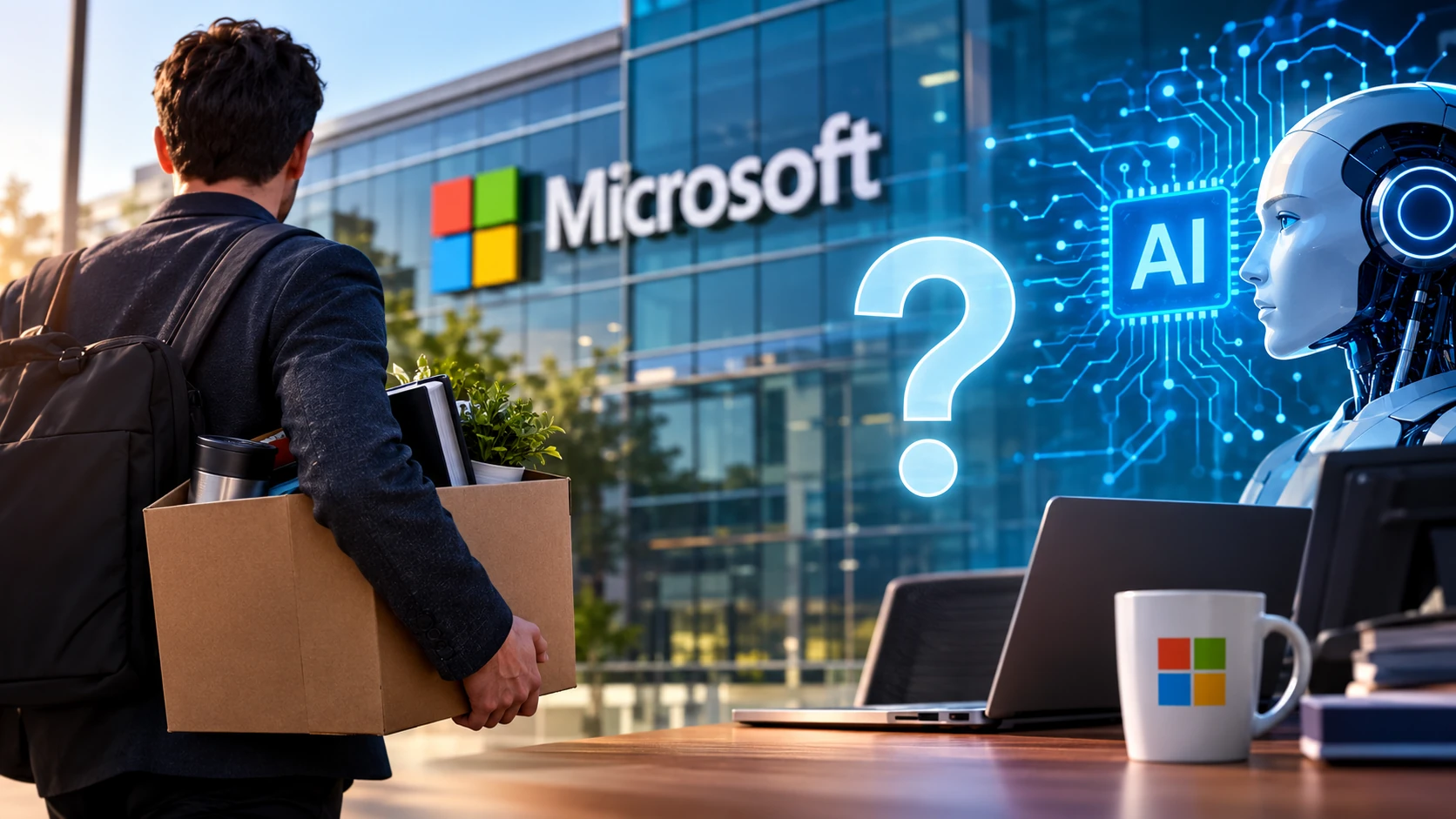
Microsoft is offering voluntary exit packages to tens of thousands of employees as it invests billions in artificial intelligence. But is AI replacing human workers, and should Windows users be worried? The answer to the second question is probably not.
Microsoft has launched a Voluntary Exit Offer (VEO) covering approximately 60,000 eligible employees. That is a substantial portion of its global workforce, and it raises questions about the future of employment in the technology industry.
The timing is hard to ignore. Microsoft is investing heavily in AI infrastructure, expanding Copilot and integrating AI into more of its products. At the same time, the company is looking for ways to restructure its workforce and manage costs.
Are these employees being replaced by AI? And could the changes affect the Windows operating system that millions of people use every day?
Let us look at what this means.
60,000 employees can leave. But will they?
The first thing to understand is that Microsoft is not necessarily firing 60,000 people.
The Voluntary Exit Offer gives eligible employees the option to leave the company with financial compensation. Eligibility depends on their organisation and employee level, and participation is voluntary.
The programme is part of Microsoft's wider workforce restructuring. It does not mean every eligible position will disappear, nor has Microsoft confirmed that AI will directly replace the people who leave.
However, voluntary departures can help a company reduce its workforce without resorting to compulsory redundancies. If positions are subsequently left vacant, consolidated or automated, the company may be able to accomplish the same work with fewer employees.
That possibility is what makes the announcement significant.
Is AI taking their jobs?
Microsoft is spending enormous sums on AI infrastructure, including data centres, specialised computing hardware and cloud services.
AI tools can already assist with software development, customer support, writing, data analysis and routine administrative work. Tasks that previously required hours of human effort can sometimes be completed much faster.
For a company employing hundreds of thousands of people, even modest productivity improvements across multiple departments could change its staffing requirements.
But automating tasks is not the same as replacing entire jobs. Companies still need people to make decisions, verify AI-generated results, manage customers, solve unusual problems and take responsibility for their products.
The evidence does not establish that Microsoft's voluntary exit programme is an AI-driven replacement exercise. Cost management, organisational changes and shifting business priorities may all contribute.
The broader question remains: when AI allows a company to do more with fewer people, how many workers will it ultimately need?
Will this affect your Windows PC?
Probably not in any immediate or noticeable way.
Windows is a mature product developed and maintained by large engineering teams. Microsoft has spent decades building its operating system, and its future does not depend on every current employee remaining in their position.
If some employees leave, Microsoft can redistribute responsibilities, hire specialists in other areas, automate parts of its development process or simply eliminate work it no longer considers necessary.
AI could change how Windows is developed, tested, maintained and supported. That does not automatically mean Windows itself will become worse or that development will stop.
There is also no confirmed evidence that this particular voluntary exit programme will result in a major reduction in Windows development staff.
For everyday users, the more relevant issue is Microsoft's existing direction for Windows.
Windows is already bloated. Does Microsoft really need more AI?
Let us be honest. Windows does not need thousands of additional AI features to remain a useful operating system.
Windows has become increasingly complicated over the years. Advertising and promotional content appear in parts of the interface. Some built-in applications and services are unwanted by many users. Settings and configuration options are spread across multiple interfaces, while features that should be straightforward can require unnecessary effort to locate.
Now Microsoft is adding more AI functionality, including Copilot integrations, while continuing to push its broader Microsoft account and cloud ecosystem.
Some of these features will be useful to certain people. Others will be ignored by users who simply want an operating system that runs their applications reliably.
The problem is not necessarily that Microsoft employs too many people. It is that the company has repeatedly expanded Windows beyond what many users actually need.
A lean, stable operating system with sensible defaults, fewer distractions and better performance would be welcome.
Reducing headcount does not guarantee that result. If Microsoft removes experienced engineers while continuing to add unnecessary features, Windows could become harder to maintain rather than simpler. Equally, if automation helps its remaining teams fix bugs faster and improve reliability, users could benefit.
The outcome depends on Microsoft's priorities, not just the size of its workforce.
What about Windows updates and security?
Windows users should not assume that fewer employees automatically mean fewer security updates or slower bug fixes.
Microsoft can continue maintaining Windows with a different workforce structure, and AI-assisted development may help with testing, code analysis and identifying certain defects.
However, AI-generated code and automated testing still require competent oversight. Security vulnerabilities can be subtle, and systems used by millions of people need careful validation.
The real test will be the quality of Windows updates, the speed at which Microsoft addresses security problems and whether the company continues supporting its products properly.
Those are measurable outcomes. The number of employees accepting a voluntary exit package is not, by itself, a reliable indicator of Windows quality.
For now, there is no reason to change your Windows installation, stop installing security updates or assume your PC will be affected by this announcement.
The bigger issue is the future of work
Microsoft's announcement highlights a challenge facing the entire technology industry.
AI promises higher productivity, lower operating costs and new products. But those benefits may also allow businesses to operate with smaller teams.
Some workers will move into new roles. Others may need to retrain. Some positions may disappear altogether.
For employees, learning to work effectively with AI tools could become increasingly valuable. For employers, the challenge is to use automation responsibly while retaining the expertise needed to maintain complex products and services.
For customers, the question is simpler: will these investments produce better products and services, or will companies use AI primarily to cut costs while leaving users with the same problems?
That remains to be seen.
The Compourri verdict
Microsoft's offer to approximately 60,000 eligible employees is significant, but it does not prove that AI is directly replacing those workers.
The company is restructuring while investing heavily in AI, and automation may contribute to how it operates in the future.
For Windows users, there is no immediate reason to panic. The operating system will continue to be developed and maintained, although AI may increasingly influence how that work is done.
Our bigger concern is what Microsoft chooses to do with Windows itself.
Windows does not need to become an AI-powered everything-platform. Many users want a reliable, secure operating system that runs their software without unnecessary advertising, bloat or cloud dependencies.
If AI helps Microsoft deliver that experience, it could be a positive development.
If Microsoft simply removes employees, adds more AI features nobody asked for and leaves Windows as bloated as ever, users will not have much reason to celebrate.
The real question is not whether Microsoft can operate with fewer employees. It is whether it can deliver a better Windows experience with the resources it has.