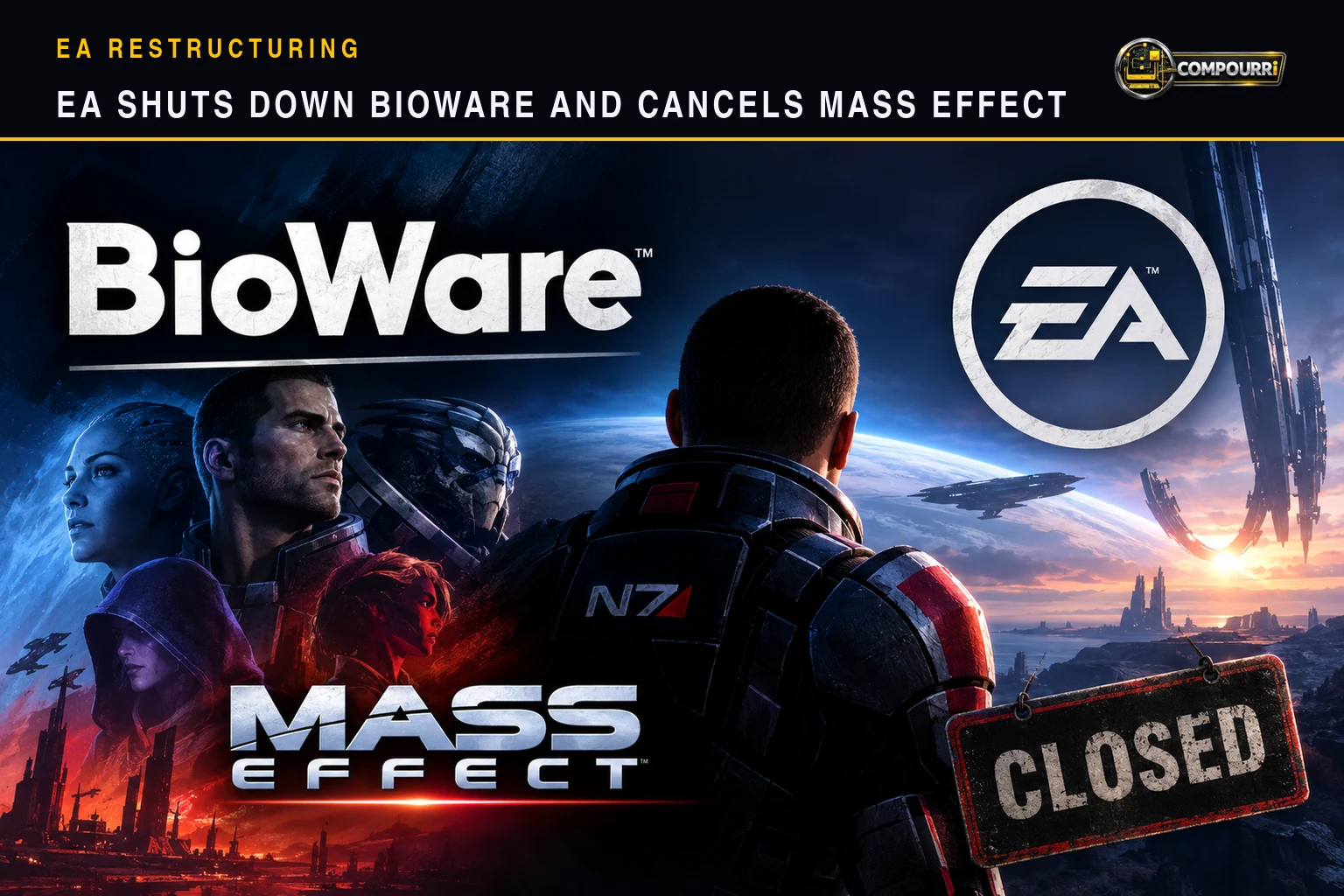
BioWare is closing its doors after more than three decades of role-playing games. Electronic Arts has confirmed that development on the next Mass Effect game has ended.
Electronic Arts announced the closure of BioWare and the cancellation of its next Mass Effect project on 21 October. The decision forms part of a broader restructuring in which EA moves resources towards projects it believes offer better commercial returns.
BioWare confirmed the news in a farewell message published the same day, ending more than three decades of game development under one of the industry's most recognisable role-playing studios.
The end of a legendary studio
Founded in 1995, BioWare helped shape modern role-playing games through memorable characters, branching narratives and player choices with lasting consequences.
Its legacy includes Baldur's Gate, Neverwinter Nights, Star Wars: Knights of the Old Republic, Dragon Age and Mass Effect. Those games established the studio's reputation for combining cinematic storytelling with deep role-playing systems.
For many players, a BioWare game was about more than combat or collecting loot. It offered companions worth caring about, difficult moral decisions and fictional worlds that felt alive.
The Mass Effect trilogy became the studio's defining achievement for a generation of gamers. Its interconnected story, memorable crew and decisions that carried across three games showed what a long-form, choice-driven science-fiction role-playing game could do.
That legacy makes today's announcement painful.
The next Mass Effect is cancelled
EA has confirmed that it will not proceed with the next Mass Effect project, which remained in early development at BioWare.
The next instalment was announced in December 2020, with later teasers pointing to a return to the series' established universe. Fans hoped the new game would build on the original trilogy's legacy. Those hopes are now on hold.
It matters that this is not the same as the permanent end of the Mass Effect franchise. EA has confirmed that development is ending and BioWare is closing. It has not announced that the intellectual property itself is being retired.
Whether another studio could eventually revive the franchise remains unknown. For now, there is no confirmed replacement project.
Corporate restructuring comes at a human cost
The BioWare closure forms part of a wider EA restructuring expected to affect approximately 400 employees across the company, according to reporting by Bloomberg. Around 50 of those positions are at BioWare.
EA says it wants to concentrate resources on fewer projects with stronger commercial prospects. Its stated priorities include Battlefield, Apex Legends and EA SPORTS, alongside upcoming projects based on Star Wars and Marvel's Iron Man.
The company also went private in August 2026 after a $55 billion acquisition led by Saudi Arabia's Public Investment Fund, Silver Lake and Affinity Partners.
The timing raises questions about how new ownership and new financial priorities could shape creative decisions. EA has not attributed BioWare's closure to any single financial factor.
For the developers affected, the consequences arrive immediately. Years of experience, creative work and institutional knowledge are lost as the studio shuts down.
How did BioWare reach this point?
The closure follows a difficult period for the developer.
Mass Effect: Andromeda, released in 2017, received a mixed reception and struggled to match the reputation of the original trilogy. Anthem, released in 2019, moved the studio towards a shared-world, live-service model that never delivered the long-term success EA had hoped for.
Dragon Age: The Veilguard launched in 2024 and fell short of EA's sales expectations. EA told investors that the game reached roughly 1.5 million players in its first quarter, nearly 50% below what the company had forecast.
Those setbacks put pressure on a studio whose identity had been built around ambitious, story-driven role-playing games. After The Veilguard, the team turned its attention to the next Mass Effect game.
That project will now end before players get the chance to experience it.
It would be simplistic to blame the closure on one game or one decision. Game development has become increasingly expensive, and publishers face pressure to deliver enormous commercial returns. The closure also highlights the risks of an industry where decades of creative achievement do not protect a studio when its recent releases fail to meet corporate expectations.
Our opinion: BioWare put the message ahead of the game
The rest of this section is Compourri's opinion. The reporting above is not.
BioWare spent its final decade putting ideological messaging ahead of narrative, and it lost the audience that made the studio in the process.
That is an opinion, but the evidence behind it is a sales figure. The original games asked the player to decide. Mass Effect gave you a moral axis and let the consequences fall where they may. Dragon Age gave you a grey world full of compromised characters who did not exist to lecture you. A player who disagreed with those games could still love them, because the games were busy trying to be a good story rather than a good argument.
The Veilguard reversed that priority. Its marketing pushed romance and companion relationships as the main event, and the story treated nearly every antagonist as a misunderstood victim who only needed the right conversation. The campaign drew attention across the gaming press. It also repelled the audience that had funded thirty years of BioWare, because a large part of that audience came for the grey and the hard choices and the sense of a world that did not need correcting.
The numbers were never ambiguous. EA reported that The Veilguard engaged about 1.5 million players in the quarter, roughly 50% below the company's own projection, and cut its full-year guidance from mid-single-digit growth to a mid-single-digit decline. On Steam the game landed with Mixed Reviews and a concurrent peak in the region of 89,000 players. It was the first BioWare title to miss a sales target by that margin.
There is a business lesson here that reaches past one studio. A story-driven role-playing game earns its audience by building characters worth arguing with. When a developer starts pre-empting that argument, players stop feeling heard and start feeling lectured, and they leave.
This is not a claim about the game's themes. Fantasy, science fiction and role-playing games have always made room for progressive politics and morally complicated stories. The trouble starts when the message becomes the product and the story becomes the delivery mechanism. Larian shows the alternative with Baldur's Gate 3, which sells freedom and consequence rather than a lecture, and reached a far bigger audience than BioWare managed with The Veilguard.
None of this excuses EA's decision, and nothing in it softens the loss of 400 jobs. But a studio that spent its final years chasing approval from a political mood rather than the loyalty of its own players handed its publisher a very easy number to cut.
What does this mean for the future of RPGs?
BioWare's shutdown matters well beyond its immediate impact on Mass Effect fans.
The studio helped popularise a style of role-playing game built around dialogue, companion relationships, consequential decisions and carefully constructed narratives. Its influence runs through the wider genre.
Other developers keep exploring those ideas, and the closure does not mean story-driven role-playing games are disappearing. The success of Baldur's Gate 3 shows there is still a substantial audience for ambitious, narrative-focused experiences.
The concern is whether large publishers keep investing in creative projects that need years of development and carry substantial financial risk.
When commercial performance becomes the dominant measure of success, studios get pushed towards established formulas, familiar franchises and safer investments rather than new ideas.
The irony is that BioWare helped build some of the very franchises that made EA a force in gaming. Its closure raises an uncomfortable question about how much value a publisher places on creative legacy once that legacy no longer guarantees commercial success.
A farewell to BioWare
In its closing message, BioWare reflected on more than three decades of shared adventures and thanked the players who brought its worlds to life.
The studio's statement acknowledged the people behind its games and the communities that grew around them, and committed to supporting its team through the transition.
For millions of players, BioWare's legacy lives on through the games it leaves behind. The friendships formed aboard the Normandy, the difficult decisions made throughout Dragon Age and the unforgettable adventures of its earlier role-playing games do not disappear with the studio.
But the cancellation of the next Mass Effect game leaves an unanswered question about what might have been. A studio that helped define an entire genre is closing, and another ambitious project joins the growing list of games that will never reach players. BioWare's story may be over, but its influence on gaming is not.
Editor's note: this article reflects the information confirmed on 21 October 2026. Further details may emerge as the story develops.
Sources
- Electronic Arts – Building EA's Next Chapter, the official announcement on the BioWare closure
- BioWare – BioWare Update, the farewell statement confirming the closure
- Bloomberg – EA to cut 400 jobs and shut down BioWare
- Reuters – EA to shutter BioWare studio and cut jobs as it narrows the game slate
- The Verge – EA is shutting down BioWare, with the EA and BioWare statements
- IGN – BioWare shutting down and the next Mass Effect cancelled
- Electronic Arts – Completion of the acquisition by PIF, Silver Lake and Affinity Partners
- GameSpot – Dragon Age: The Veilguard player numbers against EA's expectations