
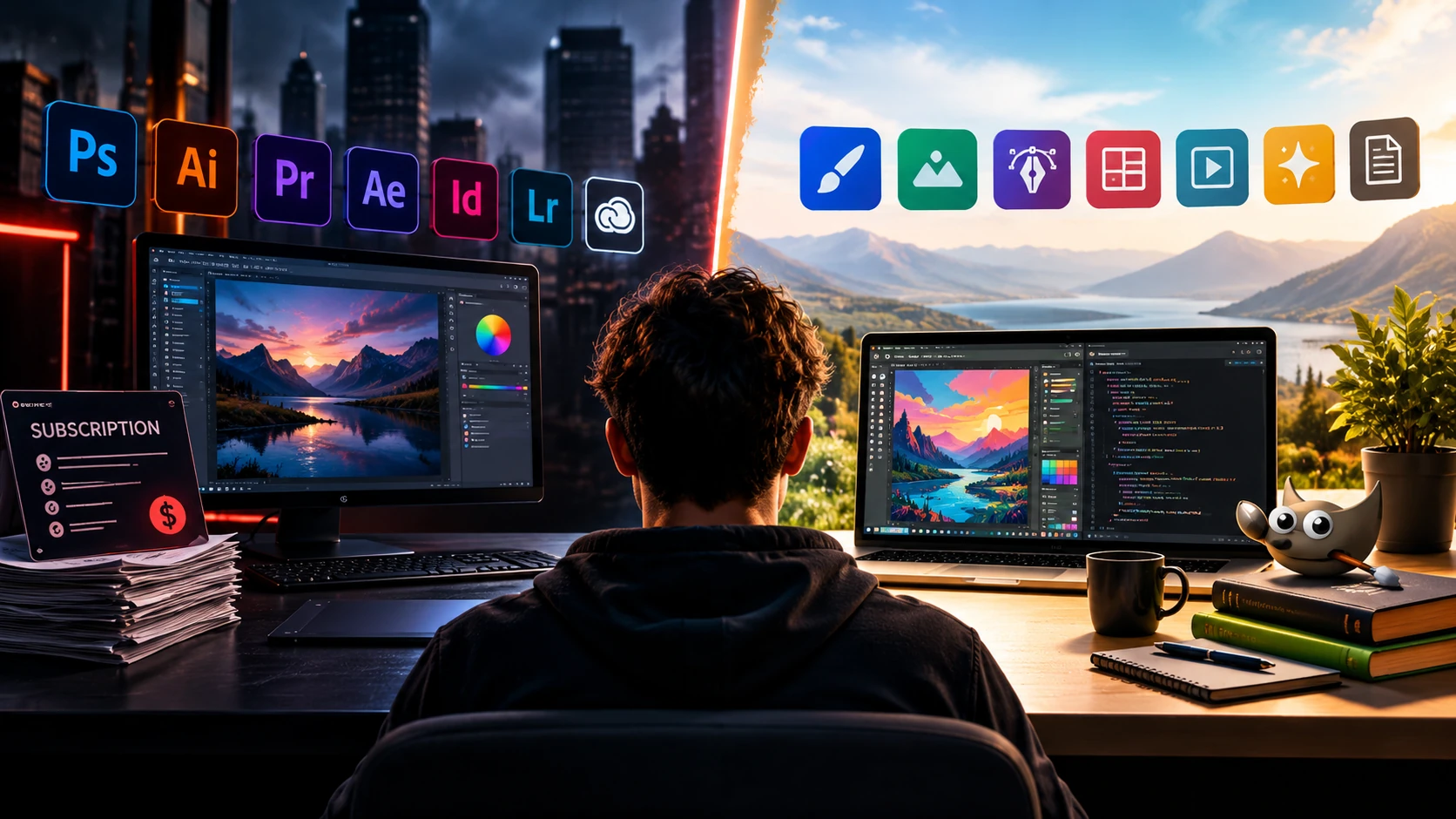
An open-source suite written in Rust with help from Claude is challenging the software subscription model. But can a tiny AI-assisted project really compete with Photoshop, Premiere Pro and the rest of Adobe's Creative Cloud?
For years, Adobe has been the heavyweight champion of creative software. Photoshop became the industry standard for image editing. Illustrator dominates many vector-design workflows. Premiere Pro, After Effects and InDesign are deeply embedded in professional creative industries.
But Adobe has a problem. Its software is expensive, its subscription model has frustrated customers, and alternatives have become increasingly capable.
Now, a developer has taken that frustration and turned it into an ambitious open-source project called ArtCraft. Using Anthropic's Claude Opus 5.5 AI model, developer Brandon Thomas is building Rust-based alternatives to seven major Adobe applications.
The ambition is enormous. The software is free, the source code is open, and the project aims to recreate the tools people know from Adobe's creative suite.
It is also nowhere near finished.
Nevertheless, ArtCraft raises an important question: if AI can help one developer build software that once required large engineering teams, how much longer can expensive software subscriptions rely on customers having no realistic alternative?
The Rust Clone That Wants to Replace Adobe
ArtCraft isn't just a Photoshop imitation. Its project includes seven applications intended to cover much of Adobe's creative ecosystem.
- PhotoCraft: Image editing, targeting Photoshop's functionality.
- LightCraft: Photo management and editing workflows associated with Lightroom.
- VectorCraft: Vector illustration, similar to Illustrator.
- DesignCraft: Page layout and desktop publishing, targeting InDesign.
- FilmCraft: Video editing, targeting Premiere Pro.
- EffectCraft: Visual effects and motion graphics, targeting After Effects.
- PrintCraft: PDF workflows associated with Acrobat Pro.
The unusual part is how these applications are being developed. Rather than reproducing Adobe's software through a traditional, large-scale engineering effort, Thomas is using AI to accelerate development in Rust, a programming language known for performance and memory safety.
The project is intended to provide native desktop applications alongside browser-based versions compiled to WebAssembly. Its code is released under open-source licences, allowing developers to inspect, modify and contribute to it.
That is a significant ambition. It is also important to understand what the project is not: a finished, fully compatible replacement for seven mature professional applications.
Early testing has exposed missing features, bugs, performance problems and gaps in format support. The applications are in early alpha, and claims of rapid feature parity should be treated as goals rather than guarantees.
Still, even an unfinished project can demonstrate how much AI-assisted development has changed the economics of building software.
Adobe Helped Create the Demand for an Alternative
Adobe's move away from traditional software licences and towards subscriptions was a turning point.
Instead of buying a version of Photoshop and keeping it, customers increasingly had to maintain an active subscription to continue using the software. For Adobe, recurring revenue provided a predictable business model and a steady stream of income.
For customers, however, it changed the relationship with the software.
You could spend years learning an application, building workflows around it and creating files that depended on it. Yet access to the software could disappear when you stopped paying.
A subscription also means that a customer who only needs Photoshop occasionally may end up paying continuously for access to tools they use infrequently.
There are legitimate reasons for subscriptions. Software requires maintenance, security updates, ongoing development and customer support. Cloud services and generative AI features also have real operating costs.
The problem arises when the subscription becomes more important than the customer's experience.
The Cancellation-Fee Controversy
Adobe's reputation took another hit when the US Federal Trade Commission and the Department of Justice pursued legal action over alleged deceptive subscription practices.
In June 2024, the FTC announced a case alleging that Adobe obscured early termination fees and made cancellation unnecessarily difficult. Under the annual plan billed monthly, cancelling during the first year could trigger a fee equal to 50% of the remaining payments.
In March 2026, the US Department of Justice announced a $150 million settlement and injunction to resolve the government's allegations. The agreement includes requirements for clearer fee disclosures and easier cancellation.
This is more than a minor customer-service complaint. It highlights a fundamental weakness in subscription businesses: customers may accept recurring payments, but they do not want to feel trapped by them.
The broader practice is often called a dark pattern: a design choice that steers people into decisions they might not otherwise make, or makes it unnecessarily difficult to reverse them.
Adobe's Share Price and the Failed Figma Deal
Adobe's challenges extend beyond cancellation policies.
In September 2022, Adobe announced plans to acquire Figma, the collaborative interface-design platform, for approximately $20 billion. The proposed acquisition raised concerns about competition in the design-software market.
The transaction was abandoned in December 2023 after Adobe and Figma concluded that there was no clear path to the necessary regulatory approvals in the UK and Europe. Adobe paid Figma a $1 billion termination fee.
The deal became a costly reminder that Adobe could not simply buy every promising competitor and absorb it into its own ecosystem.
It also showed how much investors were being asked to pay for the future of creative software. Figma's continued growth as an independent company reinforced the importance of competition in the market.
Adobe's share price has also faced pressure over concerns about future subscription growth and the uncertainty surrounding AI's impact on established software businesses. Those movements have multiple causes, however. It would be misleading to attribute Adobe's stock declines to ArtCraft, which has only recently attracted widespread attention.
The financial story is bigger than one open-source project: investors must now consider whether established software companies can continue to grow at the same rate when AI lowers the barriers to building competing products.
Canva, Affinity and the Changing Economics of Creative Software
Adobe does not face competition from AI alone. Other companies have been chipping away at its dominance for years.
Canva made graphic design accessible to people who never wanted to learn a complicated professional application. Its browser-based tools let businesses, schools, marketers and ordinary users produce social-media graphics, presentations and promotional material with relatively little training.
It competes with Adobe Express and overlaps with some of the work traditionally done in Photoshop and Illustrator. Its success demonstrates that many customers value convenience and accessibility over having every professional feature available.
Then there is Affinity.
In October 2025, Canva announced that its redesigned Affinity application, combining photo editing, vector design and page layout, would be free for everyone. This gave users access to serious creative tools without the traditional recurring software fee.
That is a major development. Affinity was already a credible alternative to Adobe's professional applications. Making its core creative software free removes a significant barrier for freelancers, small businesses and hobbyists.
It also creates an interesting business question. Canva can make professional tools available at no charge while competing through its wider platform and paid offerings. It does not need every user to pay for the same product in the same way Adobe's traditional subscription model encourages.
And Then There Is GIMP
We should not overlook the alternative that has existed for decades.
GIMP, the GNU Image Manipulation Program, is free and open source. It offers layers, selections, masks, filters, colour adjustments, painting tools and a broad range of image-editing capabilities.
It is not a new AI experiment. It is a mature project with a long history, a community of contributors and no mandatory monthly subscription.
GIMP has limitations. Its interface and workflow differ from Photoshop, and professional users may encounter differences in specialised features, automation, colour-management workflows or compatibility with complex PSD documents.
But for many people, GIMP is more than enough.
A small business owner who needs to resize photographs, remove backgrounds, create promotional graphics or prepare images for a website may have little reason to pay a monthly fee for Photoshop.
That is where the Adobe subscription model becomes vulnerable. Not every customer needs the full professional ecosystem. Many simply need a reliable tool that gets the job done.
And unlike ArtCraft, GIMP is not waiting to become a usable image editor. It already is one.
So, Is the Rust Photoshop Clone Actually Any Good?
The honest answer is: promising, but not ready to replace Photoshop for most professional workflows.
Early testing of ArtCraft's PhotoCraft application has shown that basic image-editing tasks are possible. Users can work with layers, make selections, move objects, apply colour adjustments and add text.
However, early reviews have also identified shortcomings in format support, performance, saving workflows and general polish. Some everyday features that professionals take for granted are still missing or unreliable.
Photoshop is the result of decades of development. It supports a vast ecosystem of plugins, specialised tools, automation, professional file formats and workflows that businesses depend on.
Matching its interface is one thing. Matching its reliability, depth and compatibility is another.
The project's small size and ambitious feature list are impressive, but a lightweight application is not automatically a better application. A professional editor must handle large files, complex documents, colour accuracy and predictable output without losing work or breaking established workflows.
ArtCraft could become a useful alternative as development continues. Right now, however, it is better viewed as an experiment worth watching than a tool on which to base a professional production pipeline.
For anyone looking to leave Adobe today, GIMP and Affinity are more practical places to start.
What Does This Mean for the SaaS Business Model?
ArtCraft points to a broader challenge for software companies.
AI-assisted development can reduce the time and resources required to build software. A small team, or even one experienced developer, can use AI to generate code, explore unfamiliar APIs, implement features and iterate quickly.
That does not eliminate the need for software engineering. Someone still needs to define the architecture, test the results, find subtle bugs, manage security and make sure the product works reliably. AI-generated code can be wrong, inefficient or difficult to maintain.
But the economics are changing.
If a developer can create a credible alternative to an established application at a fraction of the traditional cost, the incumbent's competitive advantage becomes less secure.
Open-source software adds another dimension. A successful project can attract contributors, allowing development to continue beyond the original creator. Users can inspect the code, build their own versions and potentially continue using the software even if the original developer loses interest.
That creates a different relationship between the customer and the product.
Instead of renting access to a tool, users may be able to own their copy, keep working offline and decide for themselves when to upgrade.
This does not mean every SaaS business is doomed. Services that depend on cloud infrastructure, collaboration, storage, specialised data or ongoing operational support have value that a standalone application cannot easily reproduce.
Adobe also has powerful advantages in its ecosystem, enterprise relationships, professional workflows and integrated AI services.
The real threat is to software companies that assume customers will keep paying simply because switching has historically been difficult.
When a capable alternative is one download away, that assumption becomes much harder to defend.
The Bigger Lesson for Software Companies
Customers are not necessarily opposed to paying for software. They are opposed to paying for software that feels overpriced, restrictive or unnecessarily difficult to leave.
Adobe's controversy helped create an audience receptive to alternatives. Canva and Affinity have shown that creative tools can reach large audiences without requiring everyone to buy the traditional professional subscription. GIMP has demonstrated the staying power of open-source software.
ArtCraft adds AI to that equation.
It may not replace Photoshop next month, and its developers have a long road ahead. But it illustrates how quickly the cost of challenging established software companies can fall when experienced developers use AI effectively.
For consumers, that is encouraging. More competition means more choice, and more choice gives customers greater bargaining power.
For businesses, it is a warning. A subscription is a payment arrangement, not a guarantee of customer loyalty.
The future of creative software may not belong to the company with the biggest application. It may belong to the company that gives customers the best reason to stay.
Sources
- Ars Technica – AI developer takes aim at Adobe with open-source clones
- GitHub – ArtCraft / PhotoCraft source code
- US Federal Trade Commission – Action against Adobe over fees and cancellation
- US Department of Justice – Adobe agrees to $150 million settlement and injunction (March 2026)
- Adobe – Adobe and Figma mutually agree to terminate merger agreement
- Reuters – Figma IPO chalks one up for trustbusters
- Canva – Announcement of the all-new free Affinity