
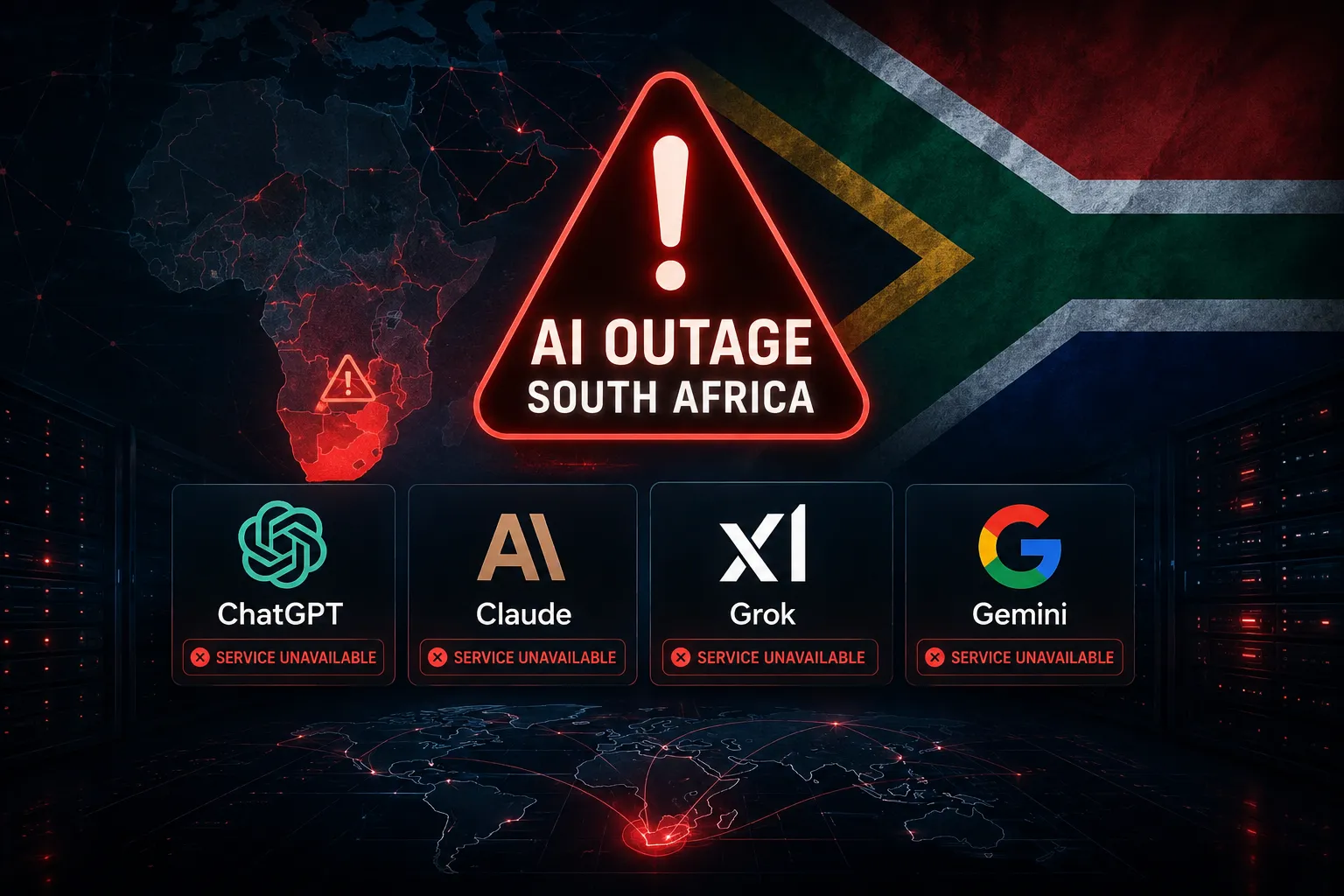
South African users found major AI platforms unavailable on Thursday afternoon, exposing how heavily modern artificial intelligence relies on shared cloud infrastructure.
Simultaneous Failures Across Competing Platforms
If you tried asking ChatGPT, Claude, Grok or Gemini a question on 3 September 2026 and hit an error screen, you shared the experience with users around the world. Several major AI services suffered simultaneous outages, with South African reports climbing rapidly from 16:30.
OpenAI took the heaviest hit locally. Local outage reports spiked past 600 within thirty minutes, while the official OpenAI status page initially claimed all systems ran normally. Anthropic noted elevated error rates across multiple models and began investigating at 15:26 South African time. X acknowledged downtime for Grok, and Google Gemini users experienced intermittent errors alongside slower response times.
The Shared Infrastructure Dependency
When competing AI providers go offline together, the temptation is to assume a coordinated failure or a single shared switch. The reality is more structural.
Modern AI platforms run as massive distributed networks. While companies compete on model weights and user interfaces, they rely on identical underlying layers for cloud compute, DNS routing, content delivery, and authentication. Microsoft Azure experienced disruptions during the same window. Azure hosts infrastructure for major technology firms, though no official confirmation links Azure directly to the AI outages.
This dynamic reveals a simple truth: renting infrastructure means inheriting third-party dependencies. An AI provider trains the model, but server clusters, network switches, and fiber cables sit underneath the software stack.
South Africa Feels the Distance
International outages land differently in South Africa. Data packets must travel thousands of kilometers across submarine cables and international exchanges before reaching local routers. When upstream cloud layers fail, South African users often experience complete disconnects long after services stabilize abroad.
Downdetector spikes proved essential for local users on Thursday, confirming that the failure belonged to international servers rather than local fibre connections or browser configurations.
The Cost of Daily AI Reliance
Thursday's downtime exposed how quickly work habits have changed. Developers use AI for debugging, businesses rely on it for documentation, and technicians lean on it for troubleshooting. When cloud systems fail, cloud-native AI stops working entirely.
No internet connection means no service. No cloud infrastructure means no model.
Professionals relying on AI now keep secondary accounts active, such as pairing ChatGPT with Claude. For users prioritizing uptime and data privacy, running smaller open-weight models locally offers a viable fallback. Local models require modest hardware and lack the massive parameter counts of frontier models, but they possess one distinct advantage: they require zero internet access.
The Takeaway
Thursday's outage serves as a practical reminder that artificial intelligence sits on physical foundations. As dependency on automated assistants grows, resilience depends as much on robust server infrastructure as it does on algorithmic breakthroughs.