
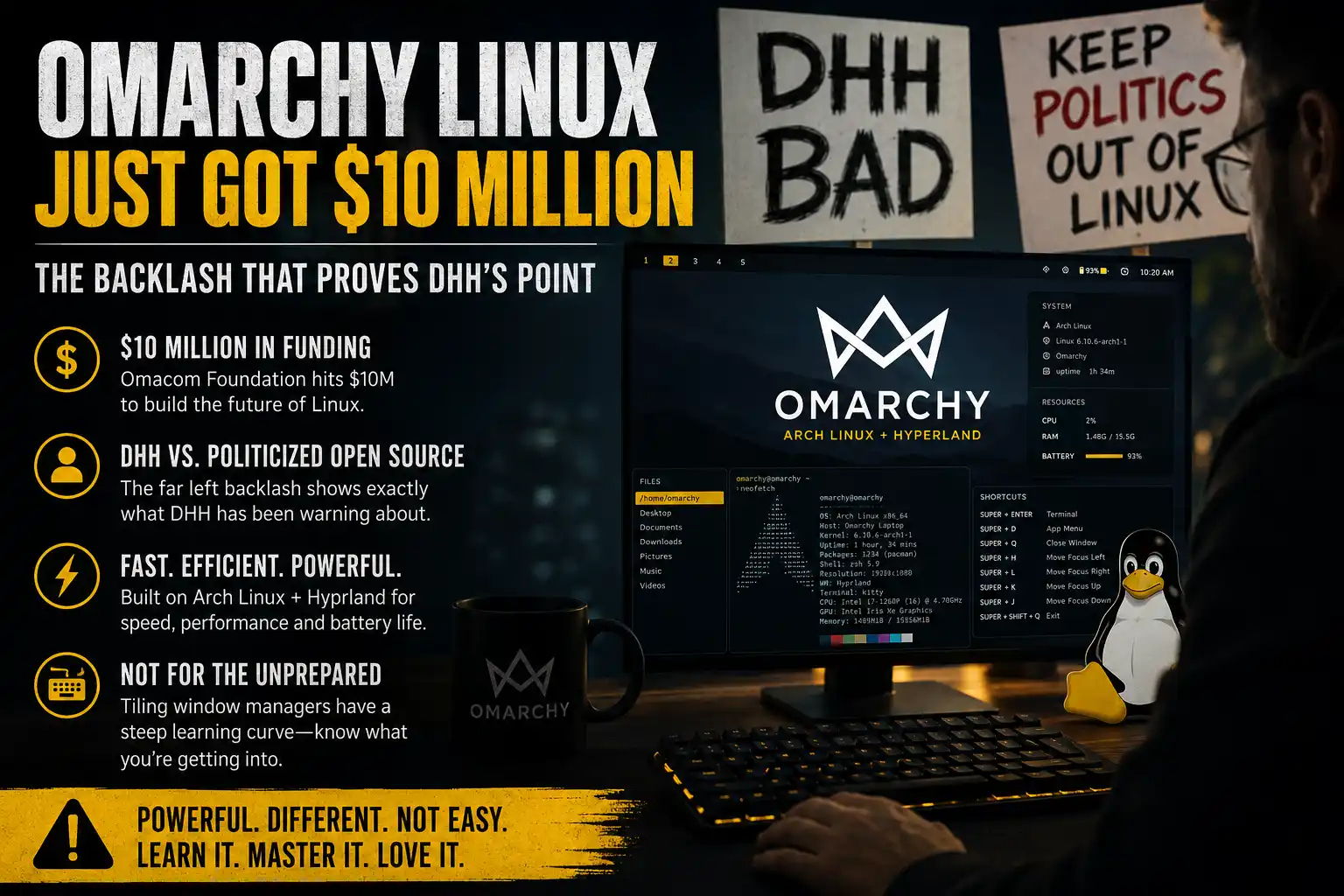
Omarchy Linux was already one of the most interesting desktop projects around. In its first month, Omarchy Quattro passed 300,000 downloads while the Omacom Foundation's funding climbed to $18.5 million pledged. The money and the rapid growth have also drawn a fierce political backlash from parts of the Linux community.
In August, the newly created Omacom Foundation announced millions of dollars in backing from some of the technology industry's biggest names. What started with $8 million quickly passed $10 million and has since climbed to $18.5 million in pledged funding.
Omarchy Quattro passed 300,000 downloads in its first month. DHH announced the milestone on X, calling the number "absolutely astounding."
$18.5 million in a matter of weeks
David Heinemeier Hansson, better known as DHH, created the Omacom Foundation. He is the creator of Ruby on Rails and co-founder and CTO of 37signals. The foundation's stated goal is larger than maintaining another Linux distribution. It funds the infrastructure, developers and open-source projects Omarchy depends on while pushing Linux toward a stronger position on the desktop.
The original launch announced $8 million from twelve founding patrons. Within days, additional funding pushed the total to $10 million. By September 9, the official Omarchy site reported $18.5 million pledged. The list of backers includes major technology figures and companies. This is no longer a hobby project kept alive by a few developers working in their spare time.
DHH intends to spend the money. The foundation has already announced funding for projects including Hyprland and Quickshell, while hiring developers to work directly on Omarchy.
Then came 300,000 downloads
The funding would be impressive on its own. The adoption numbers make it more interesting. Omarchy Quattro passed 200,000 ISO downloads in 18 days. At that point, DHH said somebody was downloading a fresh copy roughly every eight seconds. The total subsequently passed 300,000 downloads during the first month.
Downloads are not the same thing as unique installations or active users, so those numbers do not mean 300,000 people are running Omarchy. It is still an extraordinary amount of interest for a young Linux distribution. The official Omarchy site now reports more than a million ISO downloads over its first year.
And then the politics arrived
DHH has never been shy about his opinions. One of his recurring arguments is that politics should not consume every aspect of professional and technical life. He does not argue that people should avoid political beliefs. His argument is that collaboration works better when people can build things together without sharing the same worldview.
He has written extensively about keeping political disagreements separate from work and collaboration. He has also argued that open-source projects are not democracies and that users are not automatically entitled to determine a project's direction because they use it. That philosophy now sits at the center of the Omarchy debate, because a growing movement argues that Omarchy itself is political.
Stop Omarchy
The most visible example is the Stop Omarchy website, which describes itself as a campaign against the project. The site claims Omarchy is a political movement disguised as a Linux distribution. It criticizes DHH's political statements, the project's corporate and individual backers, its relationship with projects such as Hyprland and what it describes as increasing centralization in the FOSS ecosystem. It calls for boycotts of companies and individuals associated with Omarchy.
The site goes further, describing Omarchy as part of what it calls far-right extremism and alleging the project's funding is being used for reputation-washing. Those are the campaign's characterizations, not established facts. Readers should distinguish those allegations from independently verified information.
The existence of the campaign is significant. The debate around Omarchy is no longer simply whether it is a good Linux distribution. It has become whether the politics of the people funding and building open-source software should affect whether we use it. That is a much bigger question.
Is this proving DHH's point?
DHH has spent years arguing that political differences should not automatically prevent people from working together. Omarchy has attracted criticism specifically because of the political views and associations of the people involved. There is an obvious tension there.
If someone builds useful open-source software, should the software be judged on technical merit? Or should users also judge the political positions of its developers and financial backers? There is no simple answer. People are entitled to decide what software they use and who they financially support. They are also entitled to criticize developers whose political positions they find objectionable.
But there is a difference between choosing not to use software and demanding that open-source projects adopt a political position as a condition of participation. That is the part of the debate worth watching. Open source was built around the ability to inspect, modify, fork and redistribute software. If you do not like a project's direction, you can fork it. That does not mean developers must accept every contribution or listen to every user. DHH has argued that open-source projects are driven by the people doing the work, not by democratic voting.
Don't install Omarchy just because it looks cool
The other side of this story has nothing to do with politics. Omarchy is not Windows, and prospective users should understand that before installing it. Omarchy is based on Arch Linux and uses the Hyprland tiling window manager. That makes it extremely fast and efficient. It can also be confusing if you have spent years using Windows.
Windows teaches you to open applications, drag windows, minimize, maximize and use the Start menu and taskbar. Omarchy expects you to learn keyboard-driven navigation and tiling. At first, it can feel like someone removed half the controls on your computer. Then it starts making sense. Once you learn the workflow, moving windows, launching applications and navigating workspaces can become incredibly fast.
Don't install Omarchy because you saw a cool screenshot. Install it because you are willing to learn a different way of using a computer.
The performance is the real attraction
For users who make that adjustment, Omarchy has a lot going for it. Arch Linux, Hyprland and a tightly integrated desktop produce a responsive system.
Battery life is another selling point. DHH has demonstrated extremely low idle power consumption on modern Intel hardware, including a Dell XPS 14 reaching around 1.4 watts idle and more than 47 hours of theoretical battery life under specific conditions. He also reported around 16 hours of real-world mixed use on another 74 Wh system.
Those numbers will not apply to every laptop. Hardware matters enormously. But a lean, tightly integrated system can deliver excellent efficiency.
The bigger experiment
The interesting question is not whether Omarchy becomes the next Ubuntu. It probably will not. Linux does not need another distribution that tries to be everything to everyone.
Omarchy is more focused. It demonstrates what happens when someone treats the Linux desktop as a product rather than a collection of packages. The developers make decisions. The interface is opinionated. The workflow is deliberately different. The system is optimized around a particular philosophy. And there is now enough money behind it to fund developers and infrastructure at a scale most Linux desktop projects can only dream about.
The Omacom Foundation says it intends to spend the money rather than sit on it. Its September spending plan called for money raised during 2026 to be spent over the following three years, supporting developers, infrastructure, artists, competitions and the open-source projects Omarchy relies on. That is potentially good news for Linux regardless of whether you install Omarchy.
You don't have to like DHH to like Omarchy
You can disagree with DHH politically, dislike his opinions or agree with his critics. You can also think Omarchy is excellent software. Those positions are not mutually exclusive. You can equally decide not to use Omarchy because of the people behind it. That is your choice too.
The technical question remains separate: is Omarchy good? For the right user, the answer increasingly looks like yes. It is fast, efficient, visually distinctive and extremely customizable. It is attracting developers and users at an extraordinary rate, and it has attracted $18.5 million in pledged funding in a short period. That is no longer an obscure Linux experiment.
Omarchy is worth watching
The Linux desktop has spent decades trying to break through to ordinary users. Omarchy will not magically solve that problem. But it is trying something different, and 300,000 Quattro downloads in its first month suggest a lot of people are interested in that different approach.
The political controversy is not going away. The existence of campaigns like Stop Omarchy shows how deeply the argument over politics, open source and technology has become intertwined. Maybe that is a good thing. Maybe it is a distraction. Either way, Omarchy has become too significant to ignore.
If you are thinking about switching from Windows, remember the other lesson: don't switch because Omarchy looks cool. Switch because you are ready to learn it. Once you do, you might see why so many people are downloading it.
Sources
- Omarchy News – Omacom Foundation funding hits $10m
- Omarchy News – Omacom Foundation launches with $8 million
- Omarchy News – Omacom Foundation to be exclusive Hyprland sponsor
- Omarchy – Patrons
- Stop Omarchy – Boycott campaign
- Brennan Brown – Normalized Fascism in Open Source
- It’s FOSS News – Framework accused of supporting the far right over Hyprland sponsorship
- Framework Community Forum – Framework supporting far-right racists?
- NERDS.xyz – DHH gets $8 million from tech heavyweights to take desktop Linux mainstream
- 0xcc – Omarchy: Any User Process Can Escalate to Root