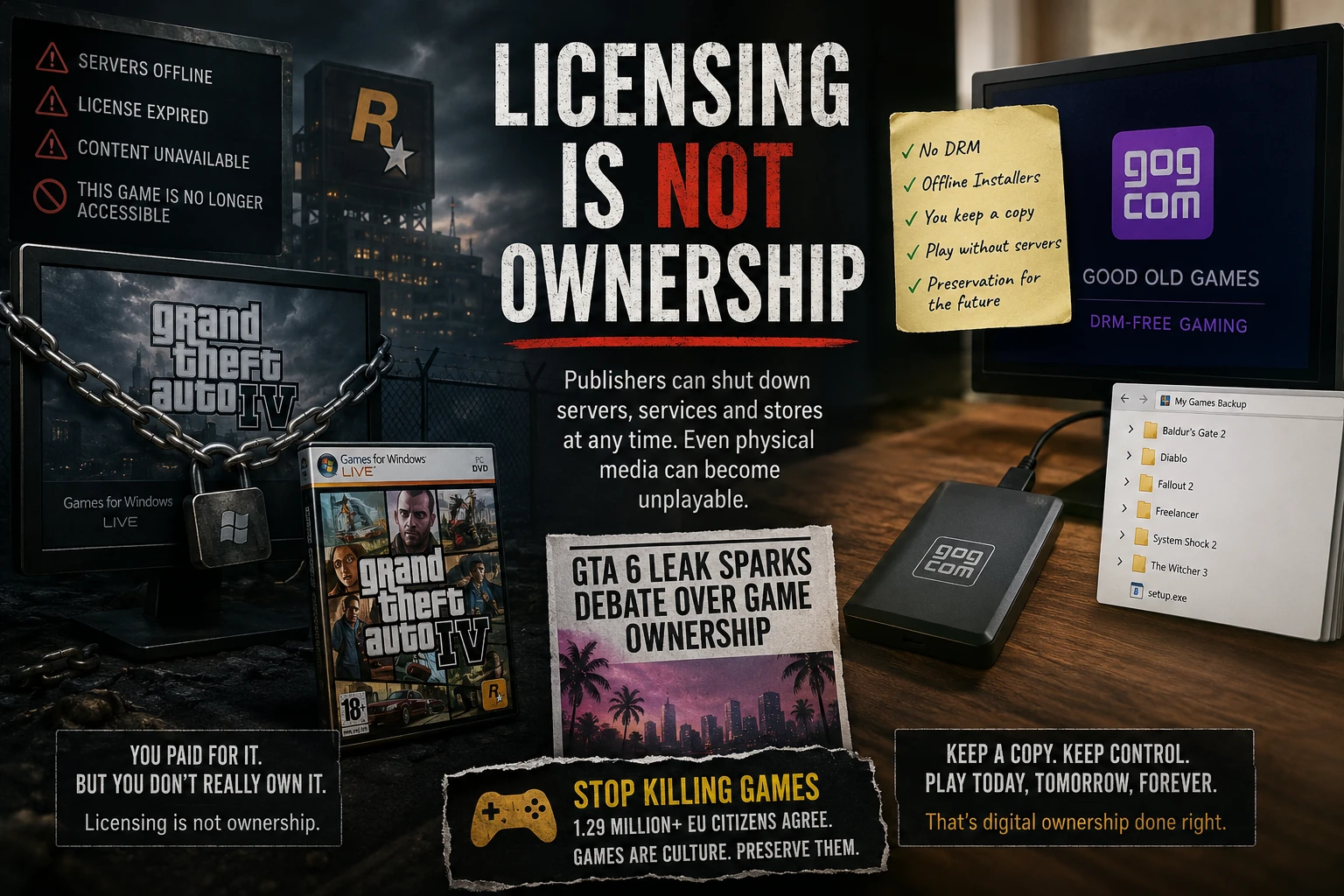
The latest Grand Theft Auto VI leak created another headache for Rockstar Games. Gameplay footage and internal material appeared online ahead of Rockstar's planned official reveal, courtesy of a group calling itself Cyberleek. The group claims the leak is a protest against the modern games industry, with demands targeting digital pre-orders, paid content already present in game files, and guarantees that single-player games remain playable when publishers shut down servers.
Let's get something out of the way first. Hacking, stealing unreleased software, and using threats to force a company to meet demands is illegal. It should be condemned. There is no legitimate consumer-rights argument that makes breaking into someone's systems and stealing intellectual property acceptable.
Dismissing the entire discussion because the messenger broke the law would be a mistake, however. Beneath the GTA 6 controversy lies a much bigger question: when you buy a game, do you actually own it?
This Argument Didn't Start with GTA 6
The debate over digital ownership has built momentum for years. Earlier this year, the European Union formally considered the Stop Destroying Videogames European Citizens' Initiative, part of the broader Stop Killing Games campaign.
The campaign gathered more than 1.4 million signatures during its collection period. More than 1.29 million were verified, comfortably exceeding the one-million threshold required for formal consideration by the European Commission. The core argument is straightforward: if consumers pay for a game, publishers shouldn't make it permanently unplayable simply because they stop supporting it.
The initiative went through hearings at the European Parliament and discussions with the European Commission. In June, the Commission stated it would engage with consumers and publishers to explore improvements to industry standards, though it stopped short of introducing a legal obligation requiring publishers to keep commercially discontinued games playable. Instead, the Commission chose to explore an industry-led code of conduct and examine existing consumer protections.
The EU discussion is now part of a larger international argument about what buying digital products actually means. And that is where GTA 6 enters the picture.
A Licence Isn't Ownership
For decades, buying a game meant buying a physical object. You bought a cartridge, CD, or DVD. You took it home, put it on a shelf, sold it, or lent it to a friend. Most importantly, the game did not need the publisher's permission every time you wanted to play it.
Digital distribution changed that relationship. Today, clicking Buy on a game store often means purchasing a licence to use the software under specific conditions rather than purchasing the software itself.
That distinction matters. A publisher can shut down authentication servers. A platform can remove a game from sale. Online services can disappear. An operating system can change. A company can go bankrupt. Suddenly, the thing you paid for no longer works.
I've Already Experienced This Problem
I hold original copies of Grand Theft Auto IV and Grand Theft Auto: Liberty City Stories on DVD. The discs still exist on my shelf. They haven't disappeared.
Physical media doesn't automatically guarantee that software remains usable, however. Grand Theft Auto IV's original PC release was built around Microsoft's Games for Windows Live infrastructure. When that service was discontinued, it created serious hurdles for the original release. The DVD survived; the software ecosystem it depended on did not.
The physical object remained. The functionality did not. That is why simply demanding that every game be released on a disc isn't the complete solution.
Physical Media Isn't the Answer to Everything
A romantic idea exists that physical media equals ownership. A box on a shelf feels more permanent than an entry in a digital library. Modern games make that distinction complicated.
A disc may contain only part of a game. Day-one patches are often essential. Additional content downloads, mandatory activation servers, and multiplayer dependencies blur the lines. Furthermore, modern PCs increasingly ship without optical drives. DVDs are slow, low-capacity, and inconvenient compared with modern broadband and solid-state storage.
A physical copy holds value for preservation, but the disc itself is not the crucial part. The crucial part is whether the software can continue to function.
GOG Demonstrates a Better Model
This is where GOG's model stands out. GOG builds its platform around DRM-free games and downloadable offline installers. Supported games can be installed without requiring the user to continually connect to a platform for verification.
That doesn't mean you own the copyright. You don't. The publisher still owns the intellectual property. But the customer receives something extremely valuable: a copy of the software that continues to function without asking a remote server for permission.
Imagine buying a game and receiving the complete game, an offline installer, no mandatory activation server, no requirement to keep a specific launcher installed, no requirement to maintain a publisher account, and a documented offline mode for single-player content. That represents a meaningful concept of ownership. You don't need a DVD; you need control over the copy you paid for.
Stop Killing Games Is Asking the Same Question
This core principle drives the Stop Killing Games movement. The argument isn't about nostalgia for plastic boxes. It's about what happens when the company behind a game decides it is finished supporting it.
The European Commission acknowledged the problem: modern games depend on publisher-controlled servers, and when those servers shut down, games can become partially or completely unplayable. Existing consumer law requires transparency about digital contracts and termination conditions, but it does not specifically require publishers to keep digital games playable after commercial support ends. That leaves a significant gap.
A company can tell you exactly what you're buying, you can agree to the terms, and years later the service can disappear. Legally, that may be permitted. From a preservation and consumer perspective, it's difficult to defend.
The Real Problem Isn't Digital Distribution
Digital distribution itself is not bad. In many ways, it's superior. Games distribute worldwide instantly. Developers deliver bug fixes and patches quickly. Manufacturing millions of plastic discs becomes unnecessary. Huge games that would require several DVDs download in a single installation. There is no reason to return to a world where every game requires a box.
The problem is dependency. A digital game shouldn't become useless because the company that sold it decides to switch off a server. If a game includes a single-player component, a way must exist to preserve that functionality when the commercial service ends. That principle unites the Stop Killing Games argument and Cyberleek's stated demands.
That Doesn't Make the GTA 6 Leak Legitimate
Distinguishing between valid consumer concerns and criminal acts remains essential. Cyberleek's manifesto attacked digital pre-orders, paid DLC, and server-dependent games, but the group also promoted its own cryptocurrency, making its claimed consumer-rights motivation difficult to take at face value.
Stealing material and claiming it benefits consumers doesn't turn theft into activism. Rockstar has every right to protect its unreleased software, and Take-Two is pursuing legal action to identify those responsible. That response is entirely reasonable. The wider discussion doesn't disappear simply because the person raising it committed a crime, however.
Will the GTA 6 Leaks Actually Hurt Rockstar?
Probably not in the way Cyberleek hopes. Damage certainly exists: Rockstar's marketing campaign suffered disruption, unreleased footage circulated widely, and Take-Two spent resources on legal enforcement. The company's share price took a temporary hit, with reports estimating that Take-Two lost roughly $2 billion in market capitalisation following the leak.
A significant difference separates temporary market reactions from long-term commercial damage. GTA 6 stands as the most anticipated game in the world. Rockstar could release a single screenshot and generate millions of dollars in free publicity. The leaks spread everywhere because people care deeply about the franchise. Every leaked video or takedown notice fuels further discussions across social media feeds.
The biggest potential threat isn't unfinished gameplay; it's spoilers. If substantial portions of the story leak before release, that could damage the experience for some players. Even then, imagining a significant number of people cancelling their pre-orders because they saw an unpolished clip on X is difficult. Rockstar's 2022 security breach leaked around 90 videos of an early development build, yet anticipation for the title only grew.
The latest leak is embarrassing, expensive, and a serious security failure. It is unlikely to halt the momentum of GTA 6.
The Bigger Threat Is What Happens After GTA 6
Publishers should focus on a deeper systemic issue. The gaming industry moves rapidly toward games as services: subscriptions, online authentication, season passes, battle passes, cloud saves, server-dependent single-player campaigns, launchers, account linking, and cloud features.
These tools serve valid purposes, but every additional dependency creates another potential point of failure. What happens in 2040? What happens when Rockstar no longer considers GTA 6 commercially viable? What happens when authentication servers become expensive to maintain, or platform policies change? What happens when the servers finally go dark? Will a copy of GTA 6 purchased in 2026 still function in 2046? That is the question worth asking.
We Need Digital Ownership, Not Physical Media
The answer shouldn't be forcing Rockstar to manufacture millions of DVDs. That belongs to yesterday's technology. The answer lies in creating a system where customers can preserve the software they purchased.
Give players the files. Remove unnecessary DRM. Provide an offline mode or an offline installer. If online services eventually discontinue, release the necessary tools or patches to keep single-player components functioning. Let the community preserve it. Let museums, archives, and enthusiasts protect gaming history.
That solution offers far more sense than pretending a plastic disc solves everything. My GTA IV DVD proves that physical media can survive while the game itself dies.
The Gaming Industry Has a Choice
Rockstar doesn't need to respond to Cyberleek. It shouldn't negotiate with hackers or reward criminal behavior. Publishers shouldn't be forced into releasing physical media simply because someone stole an unreleased game and demanded it.
Publishers should pay attention to why millions of consumers signed the Stop Destroying Videogames initiative, however. More than 1.29 million verified EU citizens supported the initiative, prompting the European Commission to examine how the industry handles the end of a game's commercial life. That is not a fringe concern; it is a warning. Consumers feel increasingly uncomfortable paying full price for software that can be revoked later.
The future of gaming doesn't require physical boxes, nor does it require mandatory online tethers. It requires preservation. Licensing is not ownership. A disc is not necessarily ownership. A digital download is not necessarily ownership. True digital ownership means that when a company eventually walks away from a game, the copy you paid for does not have to die with it. And that is a conversation worth having—even if the person who started the latest GTA 6 argument chose the worst possible way to start it.
Quick Facts
- Event: Grand Theft Auto VI development footage leaked by Cyberleek
- Industry impact: Sparked renewed debate around digital ownership, server shutdowns, and game preservation
- Regulatory context: Over 1.29 million verified signatures led to the EU's Stop Destroying Videogames inquiry
- Core issue: Single-player games becoming permanently unplayable when authentication servers shut down
- Solution: DRM-free offline installers, archival patches, and genuine software control for buyers